Human behaviour is primarily driven by two core emotions—Desire and Fear.
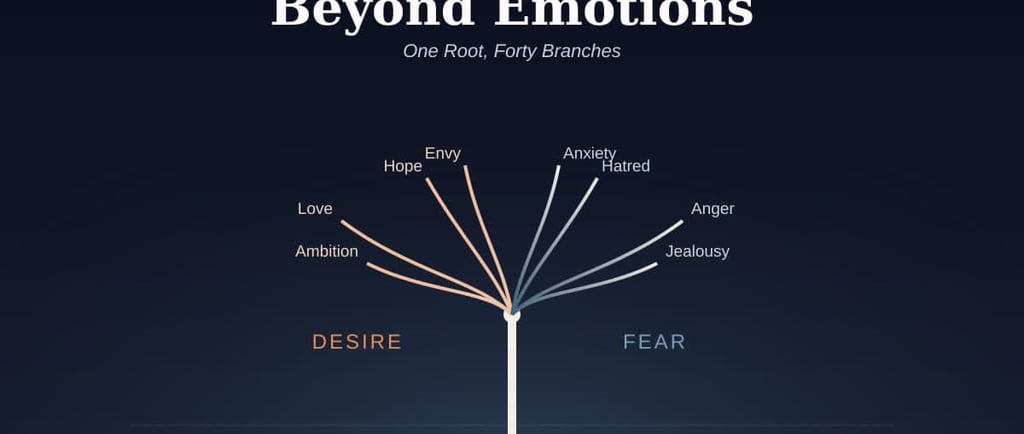
Most of the emotions that shape our daily lives are expressions, combinations, or consequences of these two.
Rajan Veda
7/12/20266 min read
I have observed, Every important decision in life is emotional. People marry because of emotions. They build families because of emotions. They start businesses because of emotions. They accumulate wealth because of emotions. They sacrifice for others because of emotions.
They forgive, They seek revenge, They trust, They betray.
History has witnessed kingdoms rise and fall because of emotions. Families have flourished because of emotions. Nations have gone to war because of emotions.
Logic certainly has a role to play. But long before logic reaches a conclusion, emotions have already influenced the direction.
Yet when we try to understand human behavior, we are confronted with an endless list of emotions. Love, hatred, jealousy, hope, ambition, pride, gratitude, trust, envy, guilt, shame, compassion, anxiety, courage and many more. Every book seems to add another layer. Every explanation introduces another category.
The result is often greater complexity, not greater clarity. What if we have been looking at the branches while ignoring the roots?
What if many of the emotions that dominate our lives are not independent at all? They are simply different expressions of something much deeper?
This article explores a simple framework. Not to dismiss the richness of human emotions. Not to replace psychology. But to ask a fundamental question.
Is it possible that much of human behavior can be understood through just two primary emotional forces? If the answer is even partly yes, then understanding ourselves may become far simpler than we have imagined.
Only Two Primary Emotions
The First is Desire
The Second is Fear
Much of human behaviour is driven by these two primary emotional forces.
The many emotions experienced in everyday life may not exist independently. They may simply be different expressions, combinations, or consequences of Desire and Fear.
If this proposition is true, even partially, then understanding human behaviour becomes less about memorising dozens of emotions and more about recognizing the two forces that quietly shape them.
How Two Primary Emotions Create Many Others
If Desire and Fear are the two primary emotional forces, then many of the emotions experienced in daily life can be viewed as their different expressions.
Consider love.
Love is often described as selfless. Yet every loving relationship fulfils something that is deeply valued. It may be companionship, belonging, trust, admiration, emotional security or simply the joy of seeing another person happy. Remove everything that is valued, and an uncomfortable question remains—what keeps the relationship alive? Love, then, is not separate from desire. It is one of its most beautiful expressions.
Now consider hope.
Hope appears when desire meets possibility. A student hopes to succeed because success is desired. A patient hopes to recover because health is desired. Without desire, hope has nothing to hold on to.
Think about ambition.
Ambition is organized desire. It pushes people to learn, create, compete and achieve. Civilization itself owes much of its progress to ambition. Yet when ambition crosses its boundary, it can become obsession.
Now look at envy.
Envy rarely appears in isolation. It arises when another person possesses something we desire for ourselves—wealth, beauty, influence, recognition or success. The object changes. The underlying desire remains the same.
What about jealousy?
Jealousy is different from envy. It is not the desire to gain something new. It is the fear of losing something already valued—a relationship, a position, trust or affection.
Consider anger.
Anger often appears when desire is blocked or when fear is activated. A promotion is denied. A promise is broken. A person feels insulted. Something valued is threatened, or something desired is prevented. Anger becomes the immediate response.
Then comes hatred.
Hatred rarely appears in a single moment. It often grows slowly from repeated fear, hurt, humiliation or perceived threat. Left unexamined, fear hardens into resentment, and resentment can eventually become hatred.
Even courage cannot exist without fear.
If there is nothing to fear, there is no courage. Courage is not the absence of fear. It is the decision that something desired is more important than the fear standing in the way.
History offers many examples.
Before the Kalinga War, Emperor Ashoka was driven by conquest and expansion. After witnessing immense suffering, the fear of repeating such destruction transformed his priorities. The same human mind that once sought victory began seeking peace. The emotions changed because the underlying forces changed.
A parent provides another example. Love encourages care and sacrifice. At the same time, fear protects the child from danger. Remove either force, and the relationship is incomplete.
An entrepreneur dreams of building a successful business. Desire creates vision. Fear warns against failure. Hope encourages persistence. Anxiety demands caution.
Several emotions appear together, yet the deeper forces remain the same.
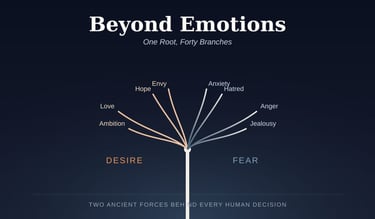
Many of the emotions shaping our daily lives are different branches growing from the same two roots. If the roots can be understood, the branches become much easier to understand.
The Biological Root
In this framework, another question naturally follows. Why are Desire and Fear so deeply rooted within us?
The answer may lie in biology.
Long before human beings built cities, wrote laws, invented money or created nations, life had already spent millions of years solving one problem—survival.
Every living creature had to find food. Every living creature had to avoid becoming food. Those that moved toward what sustained life survived.
Those that failed to recognize danger disappeared. Generation after generation, these survival mechanisms became deeply embedded in the biology of life. Human beings inherited the same operating system. Only the environment changed. Today, very few people run from wild animals. Yet the brain still responds to threat.
The threat may now be unemployment, Rejection, Failure, Public humiliation, Loneliness, Financial insecurity etc.
The body reacts differently to each situation, but the underlying emotional system remains remarkably similar.
The same is true for desire. Food is no longer the only reward. Desire now reaches for knowledge, achievement, wealth, recognition, relationships, influence, purpose, and countless other goals.
The objects have changed. The emotional machinery has not. Perhaps this is why Desire and Fear appear so powerful. They are not temporary emotions created by modern society. They are ancient emotional forces, refined over millions of years because they helped life continue. Understanding this changes the way emotions are viewed. They are part of human design. The challenge is not to eliminate them. The challenge is to understand where they are taking us.
The Missing Boundary
Fire is one of humanity's greatest discoveries. It cooks food. Keeps us warm. Melts metal. Powers industries. Without fire, civilization would not have evolved. Yet the same fire can reduce an entire city to ashes.
The problem was never fire. The problem was the absence of control.
Human emotions are no different. Desire is not dangerous. Fear is not dangerous. Unchecked desire is. Unchecked fear is.
Desire built civilizations. It inspired discoveries, inventions, businesses, families and works of art. But the same desire, when left unquestioned, becomes impossible to satisfy. A person earns enough to live comfortably. Then wants more. Then far more. Then wealth is no longer a means to live. It becomes the purpose of living. There is no finish line. The desire keeps expanding until it begins to consume the very life it was meant to improve.
Fear follows the same path. A little fear protects. Too much fear imprisons. Fear of failure stops people from trying. Fear of rejection stops people from loving. Fear of losing power can make a leader ruthless. Adolf Hitler did not become history's most infamous dictator in a single day. Extreme desire for absolute power, combined with fear, resentment and hatred, gradually erased every moral boundary. Millions paid the price.
Human beings possess a unique ability. Not simply to feel. But to examine what they feel. then Intellect come into play.
An emotion says, "Act."
Intellect asks, "Why?"
An emotion says, "Take more."
Intellect asks, "How much is enough?"
An emotion says, "Destroy the enemy."
Intellect asks, "What will remain after the victory?"
Wisdom is not the absence of Desire. Wisdom is not the absence of Fear. Wisdom is knowing when either has crossed the boundary between creation and destruction.
The Closure: Ask yourself
The next time you feel jealous, don't justify it. Ask yourself,
"What do I desire that I don't have?"
The next time you feel depressed, don't stop at the feeling. Ask yourself,
"What have I lost, or what fear has taken away my hope?"
The next time you fall deeply in love, don't merely celebrate the emotion. Ask yourself,
"What do I value so deeply in this person?"
The next time you feel proud, pause for a moment. Ask yourself,
"Is this confidence, or has it quietly become arrogance?"
They help us trace every emotion back to its source. Only then can we judge whether that emotion is helping us grow or quietly leading us toward destruction.
The greatest decisions in life are rarely made in the heat of emotion. They are made after emotion has been examined.
That is the beginning of wisdom.
Indian philosophy has long pointed in this direction. The Bhagavad Gita describes the ideal of Sthitaprajna—a person of steady wisdom who is not ruled by emotional extremes, but understands them without becoming their servant.
By: Rajan Veda